Wednesday, June 13, 2012
Commercial pilot - multi engine
Today was a great day!! An amazing day.. probably the best day in my life so far.. today I passed my commercial multi checkride. And I am extremely excited. I got the license I was looking for since I was a kid.. now I gotta build the hours to build the dream..
After the cross country phase, everything starts to go pretty fast. I started the ATP Self paced Airline Pilot Career Program on December 28th.. It is now June 13th and I am almost done with it.I am a commercial pilot with almost 100 hours of multiengine time.
It has really worked pretty well.. I have been able to keep my full time job, even though it involves a lot of international travelling; I have kept up with my family, and I am 5 months ahead on the program already.
So this was phase 4.. Next is phase 5 and final.. CFI school. Where I will have to devote 14 days of full training and study in order to get my CFI, CFII, MEI and single engine commercial. For the rest of the month, I will try to get my CFI and FOI writtens done and then I'll call ops and see what are my options regarding CFI school.

Monday, June 11, 2012
Runway Markings
The past few days I've been studying hard for my multi commercial checkride.. I have more than 200 hours of which 94 hours are multiengine. The weather in Atlanta has not been the best lately and I have my checkride schedules for June 13th. The day after tomorrow. If the weather clears tomorrow, I will be practicing multiengine maneuvers and then I will work on my cross country plan for this checkride.
Here is some interesting stuff about runway markings.. Now that you are becoming a commercial pilot, you will be visiting new airports further away and you will need to become more professional and knowledgeable in everything.
Here is some interesting stuff about runway markings.. Now that you are becoming a commercial pilot, you will be visiting new airports further away and you will need to become more professional and knowledgeable in everything.
There are three types of marking for runways; visual, nonprecision instrument, and precision instrument. The following table identifies the marking elements for each type of runway.
¹On runways used, or intended to be used, by international commercial transports.
²On runways 4,000 feet (1200m) or longer used by jet aircraft.
Precision Instrument Runway Markings

-Runway Designators. Runway numbers and letter are determined from the approach direction. The runway number is the whole number nearest one-tenth the magnetic azimuth of the centerline of the runway, measured clockwise from the magnetic north. The letters, different, differentiate between left (L), right (R), or center (C), parallel runways, as applicable.
i. For two parallel runways "L""R".
ii. For three parallel runways "L""C""R".
-Runway Centerline Marking. The runway centerline identifies the center of the runway and provides alignment guidance during takeoff and landings. The centerline consists of a line of uniformly spaced stripes and gaps.
-Runway Aiming Point Marking. (Thousand Footers) These two rectangular markings consist of a broad white stripe located on each side of the runway centerline and approximately 1,000 feet from the landing threshold.
-Runway Touchdown Zone Markers. These markings consist of groups of one, two, and three rectangular bars symmetrically arranged in pairs about the runway centerline. They are coded to provide distance information in 500 ft increments.
Nonprecision Instrument Runway and Visual Runway Markings

-Runway Side Stripe Marking. Delineate the edges of the runway. Consist of continuous white stripes located on each side of the runway,
-Runway Shoulder Marking. May be used to supplement runway side stripes to identify pavement areas contiguous to the runway sides that are not intended for use by aircraft.


-Runway Threshold Markings. They either consist of eight longitudinal stripes of uniform dimension disposed symmetrically about the runway centerline, or the number of stripes is related to the runway width. A threshold marking helps identify the beginning of the runway that is available for landing. It may be relocated or displaced in some instances.
-Relocation of a Threshold. Sometimes construction, maintenance, or other activities require the threshold to be relocated towards the rollout end of the runway. When a threshold is relocated, it closes not only a set portion of the approach end of a runway, but also shortens the length of the opposite direction runway. In these cases a NOTAM should be issuedidentifying the portion of the runway that is closed.

-Displaced Threshold. Located at a point on the runway other than the designated beginning of the runway. It reduces the length of runway available for landings. The portion behind a displaced threshold is available for takeoffs in either direction and landings from the opposite directiom. White arrows are located along the centerline in the area between the beginning of the runway and displaced threshold.

-Demarcation Bar. Delineates a runway with a displaced threshold form a blast pad, stopway or taxiway that precedes the runway. It is 3 feet wide and yellow, since it is not located on the runway.

-Chevrons. They are used to show pavement areas aligned with the runway that are unusable for landing, takeoff, and taxiing. Chevrons are yellow.
Sunday, May 27, 2012
The XC phase
I have been very busy with work and studying that I haven't been able to post in a while. Even though I'm not sure anybody reads this, but it will be a good memory for me in the future.
The second week of May I was done with my 50 hours of XC flights.. well actually I did about 47 hours so I have 3 extra hours for any emergencies (checkrides far from home or extra training). This is definitely the funnest part of the ATP Airline Career Program.
Usually how it works for a fast track student is that they will pair you up with someone for a week and a half or two weeks and you'll be doing your XC flights with that person. For me it was quite different and I think it was better. Since I am self paced, scheduling needs to check my availability and they will try to put me with another cross country student during those flights and for that reason I flew with 7 different students from PDK, LZU, BWG and FXE who also were in their XC phase and It worked pretty well. It was pretty cool to learn about other students on these cross country flights, their different personalities, learn their stories and their future plans as soon as their earn their ratings.
I visited several cities like Tampa (KPIE), Daytona (KDAB), Jacksonville (KCRG), Concord, (KJQF), Indianapolis (KEYE), Meridian (KMEI), and Knoxville (KTYS).
The only problem is that if you are going to fly from PDK; most, if not all of your XC flights are going to be out from LZU.. why? it could be because of student availability to pair you up with, or airplane availability. It sucked for me because I had to drive 1:30 hrs to get to LZU and a couple of times we would not be able to depart because of wx below minimums. Even though I flew with a student from PDK, they made us takeoff from LZU and both of us complained and the reason dispatch gave us is that there were no available airplanes for us at PDK.
By visiting other schools during my XC phase I would highly recommend Daytona, and Lawrenceville they have the best facilities on the SW. PDK has a very old simulator or I would say, very limited.. you cannot fly from the right, you are flying a Seneca instead of a Seminole. Other facilites have much more better FTDs than PDK. Another thing about PDK is that I only flew 1979 models. I had the chance to fly the 2000 Piper Seminole only once during my cross country but if you are going to PDK expect to fly 79 models. Ask that question also.
ATP just ordered Piper Seminoles with G500 and delivery started last month, If I get a job with them I really hope to be instructing in one of those :).
Why I love PDK? It is the closest facility from home and you will get good airport operations experience for communications and situational awareness, it has lots of runways and taxiways and it gets veery busy.
But that was during my XC phase in May 2012; PDK is now growing. We now have 3 instructors instead of 2 and the place is getting too small for all of us. Maybe when you read this it is not the case anymore; but do your homework and ask questions when contacting ATP.
Also my second instructor got married and left ATP.. which I still don't understand. My dad told me to accomplish my goals first and then think about marriage but anyway..I am now with my third instructor for my commercial training. He has plenty of experience and a near perfect passing record.
I took my commercial written test last weekend and scored a 96!!! I definitely recommend the Gleim book, read it from cover to cover about 3 or 4 times.
 I remember this airport from the Private Pilot Sporty's video, CDK (Cedar Key).


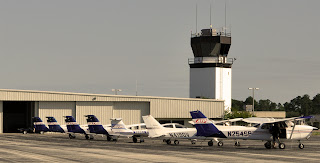

The second week of May I was done with my 50 hours of XC flights.. well actually I did about 47 hours so I have 3 extra hours for any emergencies (checkrides far from home or extra training). This is definitely the funnest part of the ATP Airline Career Program.
Usually how it works for a fast track student is that they will pair you up with someone for a week and a half or two weeks and you'll be doing your XC flights with that person. For me it was quite different and I think it was better. Since I am self paced, scheduling needs to check my availability and they will try to put me with another cross country student during those flights and for that reason I flew with 7 different students from PDK, LZU, BWG and FXE who also were in their XC phase and It worked pretty well. It was pretty cool to learn about other students on these cross country flights, their different personalities, learn their stories and their future plans as soon as their earn their ratings.
I visited several cities like Tampa (KPIE), Daytona (KDAB), Jacksonville (KCRG), Concord, (KJQF), Indianapolis (KEYE), Meridian (KMEI), and Knoxville (KTYS).
The only problem is that if you are going to fly from PDK; most, if not all of your XC flights are going to be out from LZU.. why? it could be because of student availability to pair you up with, or airplane availability. It sucked for me because I had to drive 1:30 hrs to get to LZU and a couple of times we would not be able to depart because of wx below minimums. Even though I flew with a student from PDK, they made us takeoff from LZU and both of us complained and the reason dispatch gave us is that there were no available airplanes for us at PDK.
By visiting other schools during my XC phase I would highly recommend Daytona, and Lawrenceville they have the best facilities on the SW. PDK has a very old simulator or I would say, very limited.. you cannot fly from the right, you are flying a Seneca instead of a Seminole. Other facilites have much more better FTDs than PDK. Another thing about PDK is that I only flew 1979 models. I had the chance to fly the 2000 Piper Seminole only once during my cross country but if you are going to PDK expect to fly 79 models. Ask that question also.
ATP just ordered Piper Seminoles with G500 and delivery started last month, If I get a job with them I really hope to be instructing in one of those :).
Why I love PDK? It is the closest facility from home and you will get good airport operations experience for communications and situational awareness, it has lots of runways and taxiways and it gets veery busy.
But that was during my XC phase in May 2012; PDK is now growing. We now have 3 instructors instead of 2 and the place is getting too small for all of us. Maybe when you read this it is not the case anymore; but do your homework and ask questions when contacting ATP.
Also my second instructor got married and left ATP.. which I still don't understand. My dad told me to accomplish my goals first and then think about marriage but anyway..I am now with my third instructor for my commercial training. He has plenty of experience and a near perfect passing record.
I took my commercial written test last weekend and scored a 96!!! I definitely recommend the Gleim book, read it from cover to cover about 3 or 4 times.


The Daytona Motor Speedway from the airport

An ATP Seminole and a Alleghian MD-80 at KPIE (St Petersburg, FL)

Flying along the coast

Flying over John Travolta's home (KPIE-KCRG)

The fleet at Craig

KCRG


Craig Airport - Jacksonville, FL
Thursday, April 5, 2012
ATP Stage 3 - Cross countries
This is what former students call the best stage of the Airline Career Program at ATP. It is the cross country phase. It starts just after you get your instrument rating and the first two flights consist of going with your instructor on a cross country flight. The first flight is a day IFR flight and the second is the flight back at night. At this stage you start using your instrument skills; filing your IFR flight plan, and most important, learning about CRM to prepare you for the airlines.
It didn't start good because while I was doing the preflight and I was untying one of the ropes underneath the wing.. I hit my head with the sharp edge of the cowl flap. I didn't think it was a big deal until i start seeing blood dropping from my head and suddendly covering my face. My instructor almost passed out. I covered my head with towels but they turned red in a matter of seconds.. I didn't feel dizzy but it was scary.. my head wouldn't stop bleeding. I ran towards the bathrrom and washed my face and kept trying to control the blood with the towel.. It hurt a lot more and then it stopped bleeding.
After maybe an hour and a half just sitting there and trying to see how I felt.. I decided that I was able to go flying.
I went to my instructor to Meridian, MS (again) and came back at night, I just put a towel underneath my headset just in case but I felt good all the time. For the first part he was the pilot flying and I sat on the left making all radio calls and setting navigation instruments and for the flight back I did the flying and he managed all comunications.
After this flight, scheduling will check my availability calendar (since I am self paced student; fast track must be available every day) and will send me a text message the night before telling me where am I flying to at what time and who will be with me. I forgot to say that the instructor won't be flying with me; this time it will be with another student who is on the same stage. There will be 50 hours of cross country flights.
After the flight with my instructor, I got the text message for my first cross country flight. LZU-MEI .. yes, Meridian again! for the 4th time.
I arrived at LZU at 7:30 am and the other student arrived shortly afterwards.. it was his last cross country flight so that was good because he already was familiar of what is going on. We decided that I would fly the airplane towards MEI and we were pretty sure that they were going to send us back to LZU because he only had around 5 hours left; so the flight back he was going to fly the airplane and I would be Pilot Monitoring.
That day the ceilings were very low, dispatch wouldn't let us go until noon when the weather was above ATP minimums at both airports. ATP minimums are higher than the FAAs.
Another first was that I got to fly a 2000 model of the Seminole!! I loved it!! After flying just old 79 models, this was like a BMW with wings. I loved it!
We arrived at Meridian and got some hot dogs.. there was some military training going on around.. for what I saw it was like French military men were being trained by the US. I also met a guy who delivered Cessna airplanes to Africa.. he was there flying a Cessna 172, brand new, that was going to be delivered to Angola. That really sounds like a great job..
The other student complimented me on my flying, and I also think I am doing much better on IFR communications. That flight was last Saturday and my next one will be tomorrow. I can't wait for that text message to come and tell me where am I flying tomorrow.
So far I have 49 hours on the Seminole since I started the program at ATP. I am also studying the Gleim book for the commercial written which I hope to get out of the way on mid April.




It didn't start good because while I was doing the preflight and I was untying one of the ropes underneath the wing.. I hit my head with the sharp edge of the cowl flap. I didn't think it was a big deal until i start seeing blood dropping from my head and suddendly covering my face. My instructor almost passed out. I covered my head with towels but they turned red in a matter of seconds.. I didn't feel dizzy but it was scary.. my head wouldn't stop bleeding. I ran towards the bathrrom and washed my face and kept trying to control the blood with the towel.. It hurt a lot more and then it stopped bleeding.
After maybe an hour and a half just sitting there and trying to see how I felt.. I decided that I was able to go flying.
I went to my instructor to Meridian, MS (again) and came back at night, I just put a towel underneath my headset just in case but I felt good all the time. For the first part he was the pilot flying and I sat on the left making all radio calls and setting navigation instruments and for the flight back I did the flying and he managed all comunications.
After this flight, scheduling will check my availability calendar (since I am self paced student; fast track must be available every day) and will send me a text message the night before telling me where am I flying to at what time and who will be with me. I forgot to say that the instructor won't be flying with me; this time it will be with another student who is on the same stage. There will be 50 hours of cross country flights.
After the flight with my instructor, I got the text message for my first cross country flight. LZU-MEI .. yes, Meridian again! for the 4th time.
I arrived at LZU at 7:30 am and the other student arrived shortly afterwards.. it was his last cross country flight so that was good because he already was familiar of what is going on. We decided that I would fly the airplane towards MEI and we were pretty sure that they were going to send us back to LZU because he only had around 5 hours left; so the flight back he was going to fly the airplane and I would be Pilot Monitoring.
That day the ceilings were very low, dispatch wouldn't let us go until noon when the weather was above ATP minimums at both airports. ATP minimums are higher than the FAAs.
Another first was that I got to fly a 2000 model of the Seminole!! I loved it!! After flying just old 79 models, this was like a BMW with wings. I loved it!
We arrived at Meridian and got some hot dogs.. there was some military training going on around.. for what I saw it was like French military men were being trained by the US. I also met a guy who delivered Cessna airplanes to Africa.. he was there flying a Cessna 172, brand new, that was going to be delivered to Angola. That really sounds like a great job..
The other student complimented me on my flying, and I also think I am doing much better on IFR communications. That flight was last Saturday and my next one will be tomorrow. I can't wait for that text message to come and tell me where am I flying tomorrow.
So far I have 49 hours on the Seminole since I started the program at ATP. I am also studying the Gleim book for the commercial written which I hope to get out of the way on mid April.

My checklist after I hit my head.. ouch!

This is what I hit my head with

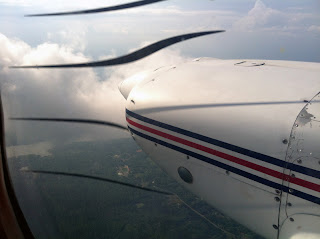
Flight towards MEI with my instructor.. there is always this efect when you take a picture to the engine.


Approaching Meridian runway 22 from the right seat

Waiting at Meridian for the sun to set

2000 Piper Seminole for my first cross county!

Flying over the clouds


Some stuff I was not able to see while being a VFR only pilot


Dobbins Air Force base while approaching LZU

Atlanta
KATL-MGGT
I have been very busy with work and have not posted since my instrument checkride. I went on a business trip to Guatemala and San Salvador during the last week of March and I had a blast.
I took some pictures from the airplane and kept track of the airline route with Fore Flight. I love the fact that everytime i see an airport or a lake or mountain from the window I can find out exactly where we are.
The approach into Guatemala was the ILS/DME-2 Rwy 1
.PNG)


I took some pictures from the airplane and kept track of the airline route with Fore Flight. I love the fact that everytime i see an airport or a lake or mountain from the window I can find out exactly where we are.
The approach into Guatemala was the ILS/DME-2 Rwy 1
.PNG)
Over the Gulf of Mexico towards MID VOR (Merida)


Flying over Coban, Guatemala

Over the city of Guatemala towards the VOR

Starting the teardrop turn inbound towards Runway 1, theres Amatitlan Lake. Challenging approach.


La Aurora International Airport - MGGT
Sunday, March 18, 2012
Saturday... the checkride
I arrived at the school at 9:30 am, I made sure I had everything I needed for the checkride with me. Foggles, money, Id's, cross country flight plan, performance charts... I finished up the airworthiness information for IFR on that morning. (Annual, VOR check, 100 hrs, Altimeter, Transponder, ELT..) It was a very busy morning; my instructor had 3 students with checkrides. One of them was a private multi-engine, a commercial single-engine and me; however, I was the only one who was going to take his test at another airport, so he had to call an instructor from KLZU to come to KMDQ with me since ATP doesn't allow solo flying for students in the Seminoles.
The instructor from LZU arrived and pretty much I handled all the radios all the way to KMDQ. We taxied to runway 2R and off we went up to 6,000 feet. The air was smooth and we requested Huntsville Approach the RNAV to runway 18 at KMDQ.

We arrived at Mr Clyde Shelton's office. It was pretty impressive, he had tons of awards and pictures with Geoge Bush, McCain, etc. He told us some nice stories about the good ol' days of flying and computers, very nice person.
We went ahead and started the oral; I think it went pretty good but you also learn a lot from him. The first question he asked me was if I knew how to calculate Va.. I didn't.. he provided me with a piece of paper with the formula written and asked me to calculate Va for our flight.


I felt I didn't start good.. he then went ahead and started asking questions about the cross country flight that I planned and all the weather resources, weather charts, approach plates, scenarios.... Then he went ahead and briefed me about our flight.
Mr Shelton really gave me a workout in the air, I contacted Hunstville approach to request practice VFR approaches. The ILS at KMDQ was out of service so we were going to do that at KHSV runway 18L with one engine inoperative, then we went direct to RQZ VOR for a VOR-B approach, circle to land runway 18, then tune to the IAF for the GPS runway 18 touch and go, back to intercept the 070 radial from RQZ, do a 10 DME arc to the 044 radial inbound that have to be interrupted because another airplane was flying towards us.. but the arc was pretty good. Then we went back into the radial and he covered my HSI and my Attitude Indicator and we hold on the 8 DME 044 radial with just the clock and magnetic compass. After that we went ahead and did unusual attitudes and by that time I got pretty dizzy. For the end we went ahead and we did a PAR.. he would tell me headings, altitudes, rate of descents and speeds to the threshold of the runway.:my first Cat III landing and it was the smoothest of all 3!! Bottom line.. I passed, I am instrument rated now, I filed my first IFR flight back and we logged some actual instrument. I celebrated last night with my girlfriend and I am ready now for phase 3 on the ATP course!!


The instructor from LZU arrived and pretty much I handled all the radios all the way to KMDQ. We taxied to runway 2R and off we went up to 6,000 feet. The air was smooth and we requested Huntsville Approach the RNAV to runway 18 at KMDQ.

We arrived at Mr Clyde Shelton's office. It was pretty impressive, he had tons of awards and pictures with Geoge Bush, McCain, etc. He told us some nice stories about the good ol' days of flying and computers, very nice person.
We went ahead and started the oral; I think it went pretty good but you also learn a lot from him. The first question he asked me was if I knew how to calculate Va.. I didn't.. he provided me with a piece of paper with the formula written and asked me to calculate Va for our flight.


I felt I didn't start good.. he then went ahead and started asking questions about the cross country flight that I planned and all the weather resources, weather charts, approach plates, scenarios.... Then he went ahead and briefed me about our flight.
Mr Shelton really gave me a workout in the air, I contacted Hunstville approach to request practice VFR approaches. The ILS at KMDQ was out of service so we were going to do that at KHSV runway 18L with one engine inoperative, then we went direct to RQZ VOR for a VOR-B approach, circle to land runway 18, then tune to the IAF for the GPS runway 18 touch and go, back to intercept the 070 radial from RQZ, do a 10 DME arc to the 044 radial inbound that have to be interrupted because another airplane was flying towards us.. but the arc was pretty good. Then we went back into the radial and he covered my HSI and my Attitude Indicator and we hold on the 8 DME 044 radial with just the clock and magnetic compass. After that we went ahead and did unusual attitudes and by that time I got pretty dizzy. For the end we went ahead and we did a PAR.. he would tell me headings, altitudes, rate of descents and speeds to the threshold of the runway.:my first Cat III landing and it was the smoothest of all 3!! Bottom line.. I passed, I am instrument rated now, I filed my first IFR flight back and we logged some actual instrument. I celebrated last night with my girlfriend and I am ready now for phase 3 on the ATP course!!


Saturday, March 10, 2012
Instrument checkride has been scheduled...
I had another instrument flight last thursday. It was my very first flight with my new instructor. I already did some sim work with him and everything it went ok.
This past thursday before our flight, my instructor was very tired. He had been flying all day and helooked kind of he was in a bad mood. He told me that my instrument checkride has been scheduled in Huntsville, AL with Clyde Shelton for Sat, February 17th . I am a little scared now, since I now don't know what to expect and apparently they are going to start using Clyde now for some checkrides since it has been pretty hard to find availability from the DPEs. The bad thing is that my mindset was that I was going to go with Mr. Fred Houston and I am very familiar with the approaches at KWDR and the area around; I already had a lot of information of how he conducts the oral test plus I had my multi engine checkride with him at the beginning of the year, so I already now what to expect on the personality side.
My instructor doesn't have any information about Clyde either.
On the good side.. this will be a great challenge. I am not familiar with the Hunstville, AL area since I've never flown there but I will do my homework and research on the approaches and areas around it. I don't have any more flights scheduled before my checkride; except for the one going up to Huntsville and back. I'll have an intensive sim work tomorrow and monday afternoon. I already finished the King school IFR checkride videos and today I will go through the ASA oral test guide. I am terrified of getting a pink slip here, I can't get it and I won't get it.
My flight for that night wasn't my best, we had to switch airplanes since the red nav light was not working on the one we filed. We did a VOR approach at Toccoa . I lost some situational awareness and busted my MDA on a GPS approach to Gainesville. My ILS back to PDK was flawless.
Keep your fingers crossed.. my next post will be on Saturday night...
This past thursday before our flight, my instructor was very tired. He had been flying all day and helooked kind of he was in a bad mood. He told me that my instrument checkride has been scheduled in Huntsville, AL with Clyde Shelton for Sat, February 17th . I am a little scared now, since I now don't know what to expect and apparently they are going to start using Clyde now for some checkrides since it has been pretty hard to find availability from the DPEs. The bad thing is that my mindset was that I was going to go with Mr. Fred Houston and I am very familiar with the approaches at KWDR and the area around; I already had a lot of information of how he conducts the oral test plus I had my multi engine checkride with him at the beginning of the year, so I already now what to expect on the personality side.
My instructor doesn't have any information about Clyde either.
On the good side.. this will be a great challenge. I am not familiar with the Hunstville, AL area since I've never flown there but I will do my homework and research on the approaches and areas around it. I don't have any more flights scheduled before my checkride; except for the one going up to Huntsville and back. I'll have an intensive sim work tomorrow and monday afternoon. I already finished the King school IFR checkride videos and today I will go through the ASA oral test guide. I am terrified of getting a pink slip here, I can't get it and I won't get it.
My flight for that night wasn't my best, we had to switch airplanes since the red nav light was not working on the one we filed. We did a VOR approach at Toccoa . I lost some situational awareness and busted my MDA on a GPS approach to Gainesville. My ILS back to PDK was flawless.
Keep your fingers crossed.. my next post will be on Saturday night...
Subscribe to:
Posts (Atom)